


 Call us:



Understanding Python Sentiment Analysis Methodology
-
 By
Kelvin Fosu
By
Kelvin Fosu
- 08/10/2021
Course Description
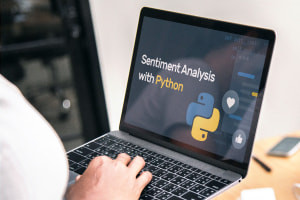
Did it ever occur to you that you can analyze a piece of text to discover the hidden sentiment behind it? As astonishing as it may appear, this is possible through Python sentiment analysis, a specific methodology to analyze copy. This process calls for a combination of machine learning and language processing, with the backdrop of a specific programming language, which is where Python comes into play. Sentiment analysis is an important topic, particularly in the business world, owing to its relevance in solving business problems. This course is about understanding the methodology of Python sentiment analysis. Sentimental analysis, often referred to as sentiment classification, is about text classification tasks. If you are supplied with a phrase, a classifier is theorized to highlight the sentiment behind it. Sentiment analysis decides if the sentiment is positive, negative, or even neutral.
Since computers cannot transform abstract language, we need to resort to a programming language to convert the text under analysis to unique numbers, interpreted to highlight the sentiment. Python is the most widely used programming language because it lets you work while integrating systems more effectively. In this course, we will emphasise PyCharm, which can provide all the tools you need for a more productive Python development. Unlike Visual Studio, Pycharm is an excellent IDE (integrated development environment) for Python. Providing more reliable code completion and the best code inspections, Pycharm is ideal for quick fixes, leading to better performance in sentiment analysis.
Another essential notion you will learn relates to TextBlob. It is a specific Python library to process textual data. TextBlob provides a simple API allowing you to dive into natural language processing (NLP), including part of speech tagging, noun phrase extraction and sentiment analysis. Other NLP includes translation and classification. In this course, we introduce you to polarity and subjectivity, which are TextBlob-related concepts. TextBlob concepts lie within the range of negative one and positive one; polarity is just a float, with negative one meaning negative statement and positive one meaning a positive statement. Subjectivity, a float-related notion, lies within the range of zero and one. A personal opinion, a judgement, and even an emotion are generally referred to as subjective sentences. Conversely, only factual information can be objective. This course will undoubtedly be helpful to IT or development professionals and students alike who have an excellent command of Python and are interested in data science.
What you'll learn in this course?
-
Technology
-
Programming
-
Data Analysis
-
Data Science
-
Python
-
Machine Learning
-
Computer Science
-
Automation
-
Natural Language Processing (NLP)
Course Curriculum

Kelvin Fosu
Accra, Ghana
 Duration
 Modules
 Certifications
